When executed correctly, successful procurement strategy has the ability to produce tangible monetary value and drive ROI across organizations—which, in turn, fuels their ability to grow and compete within their industries.
However, operating on this level requires that teams regularly monitor their procurement performance, continually seeking new ways to improve. When a mindset of “that’s the way we’ve always done things” is allowed to dominate, costs can spiral out of control unnoticed, and uninterrogated inefficiencies can diminish ROI through unnecessarily high labor costs.
Considering this challenge, we’ve compiled several procurement best practices for cost savings and efficiency in this article. Some of them can be implemented fairly quickly, while others will take longer—but all of them will make developing a robust procurement strategy and procurement strategy framework for your company possible.
Cost Savings vs. Efficiency in Procurement
When faced with the need to reduce expenses or improve profitability, many organizations respond with immediate cost-cutting measures. And in some cases, these actions may be warranted. Waste and excess creep into every system over time, so it’s nearly always a good idea to evaluate operational expenses on a regular basis.
That said, a focus on efficiency and employee productivity must go hand-in-hand with any cost-reduction conversation. Labor is one of the largest cost centers in most companies, and inefficient administrative tasks drive it higher than necessary by requiring more staffing than is truly needed to effectively manage your procurement function.
So although the following strategies touch on both cost savings and efficiency, only you will know which is a greater priority for your organization. Keep your unique situation in mind as you determine which strategies to implement first.
Revisit Your Purchasing Needs
If it’s been a while since you last revisited your purchasing needs and business requirements, now’s the time to do so. In today’s rapidly evolving business landscape, it’s crucial that companies periodically revisit their purchasing strategy, as market conditions and supplier dynamics can change significantly over time.
Because these changes have the potential to impact the price, quality, and availability of goods and services, re-evaluating your purchasing requirements may help you identify more cost-effective strategic sourcing opportunities, negotiate better contracts, and capitalize on new economies of scale.
Evaluate (and Modify) Your Current Contracts
Similarly, revisiting your purchasing needs may lead you to evaluate your current supplier contracts—and potentially modify them to more favorable terms.
Ideally, this is an exercise you should carry out every few years, as it’s possible that some of your pricing may have become uncompetitive in that time. Other factors, such as shifting economic environments, consumption patterns, and technology changes, can all result in a misalignment between your contracted terms and what market conditions will bear. Don’t be afraid to ask to revisit payment terms if opportunities for minimizing costs become apparent.
Implement Procurement Software
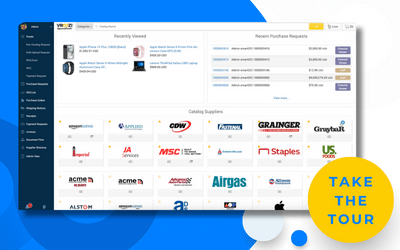
If you aren’t currently using digital procurement software, know that the right solution can lower costs by up to 45 percent while streamlining key procurement procedures. Digital procurement software like Vroozi helps you cut procurement costs and improve efficiency in several ways.
- Advanced reporting drives better spend management. Procurement programs centralize data across all stages of your procurement process. When this data is interpreted by the advanced analytics and reporting capabilities of digital procurement software, organizations are empowered to identify areas of waste that can be optimized and make better spending decisions in the future.
- Greater ease of use improves adoption. A manual or paper-based purchasing process can feel like an added burden to employees already underwater with their own responsibilities. When systems seem overwhelming, decreased adoption can result, requiring greater effort from your team to carry out core procurement functions.
- Stronger contract compliance produces savings opportunities. If your company has taken the time to negotiate discounts with pre-approved suppliers, you’ll lose money every time an employee “goes rogue” and purchases outside your established workflows. By bringing users “in system” within your digital procurement software program, you increase both contract compliance and spend under management.
When choosing the right digital procurement software for your company, prioritize options that offer the following benefits:
- A user-friendly interface: No technology can deliver its promised advantages if employees refuse to use it. Ease of use must be top of mind in any technology conversation.
- End-to-end procurement support: Adopting software that only supports one aspect of your procurement function will leave you with a patchwork of different programs, daisy-chained together in an ad-hoc manner. Instead, look for options that encompass as many of your procure-to-pay (P2P) processes as possible.
- The integrations you need: Consider your existing tech stack and how any potential digital procurement solution will fit into it. If you need to integrate your procurement software with a particular ERP, accounting system, or other technology, look for a solution that offers native integrations (or the ability to easily create custom APIs, as needed).
Identify Rogue Spending
On the subject of rogue spending (also known as “maverick spending”), keep in mind that employees who operate outside of your established processes can drive up procurement costs by purchasing from unapproved—and often more expensive—sources outside of your agreed-upon contracts.
Unfortunately, identifying rogue spending can be time-consuming without digital procurement software. With a solution like Vroozi, uncontrolled spending can be quickly identified—without it, you may find yourself conducting an internal analysis by manually combing through records (on top of your regular responsibilities).
Automate Where Possible
In the spirit of driving not just cost reductions but opportunities for efficiency as well, pay attention to process automation tools. Dramatic changes in the artificial intelligence (AI) and machine learning (ML) landscapes in recent years mean that if you haven’t taken the time to evaluate the potential of automation for your organization, you’re likely falling behind competitors.
But implementing automation within procurement strategy doesn’t have to mean giving up control (a sticking point for many organizations). You aren’t handing off critical processes to a nameless, faceless computer—instead, think of automation as an extra set of hands that can take repetitive, manual tasks off of your team so that their time and expertise can be better utilized elsewhere.
As a few examples of the way procurement automation solutions like Vroozi can drive both cost savings and efficiency, consider the following:
- Purchase classification: When employees place orders within a digital marketplace of your approved suppliers, Vroozi can automatically classify and code their requests and issue immediate approvals based on your criteria and rule sets.
- Purchase order (PO) generation: Vroozi can incorporate data from approved employee purchases and vendor contracts to generate POs dynamically, eliminating manual data entry on the part of your staff.
- Invoice matching: As invoices come in from your suppliers, Vroozi can use AI to read and match them against your system’s data using two-way and three-way matching. If everything lines up, Vroozi can be configured to approve and process payments independently.
- Exception handling: If discrepancies occur in your procurement processes, Vroozi can intelligently route any deviations observed to the correct department for further attention.
Improve Your Workflows and Operational Processes
In each area described above, controls are established to ensure Vroozi documents data appropriately and that key stakeholders have clear visibility into any executed processes. Yet, even with these guardrails in place, there are still likely to be aspects of your current procurement process that must be handled manually by your staff.
In these cases, seeking out opportunities to improve efficiency is a must. A few questions you can ask to identify potential process improvements include:
- Do we have clear documentation and standard operating procedures (SOPs) for our procurement policies and processes?
- Are the roles and responsibilities of each team member clear?
- Are there any places in our procurement processes where data is unnecessarily duplicated?
- Do procurement team members feel any of their workflows are unnecessary and redundant?
- Are there any operational silos that prevent our team members from collaborating effectively?
- Have we standardized our tools and templates to the greatest degree possible?
But don’t just ask these questions of yourself. Bring procurement team members—as well as those outside of your department who regularly interact with procurement—into the conversation to develop a more well-rounded understanding of both your current state and potential
Step Into a Leadership Role
Finally, although the strategies above provide tactical guidance on improving profitability and efficiency, the effectiveness of your procurement function shouldn’t be judged on dollars and cents alone.
Increasingly, procurement has the opportunity not just to cut costs and work more efficiently, but to truly act as a driver of competitive advantage within your organization and its industry. Think of the suggestions here as the starting point in a much larger dialogue—one that reflects procurement’s added value and positions you as a true source of strategic leadership in your company.
For more on how Vroozi can support you in delivering this level of procurement transformation, reach out to our team to book a demo or contact us with your questions.