Imagine a procurement system that allows employees to order the goods and services they need with a few clicks, automatically classifies and codes purchase requests for accounting, dynamically generates purchase orders (POs), uses artificial intelligence (AI) to read and match invoices, populates financial systems data independently, and approves matching payments on its own.
While that might sound like something out of the Jetsons, it’s actually made possible today by touchless procure-to-pay (P2P) processing. In this article, we’ll explore what touchless procure-to-pay is, how it works, and several tips to consider as you evaluate potential procure-to-pay solutions.
What is the Procure-to-Pay Process?
Procure-to-pay and procurement might sound like the same thing. But there’s a critical distinction between the two that’s important to understand before embarking on any strategic procure-to-pay decision-making.
Generally speaking, procurement refers to the comprehensive purchasing processes involved in buying goods or services. Depending on the size and scope of your organization, that might involve identifying business needs, sourcing approved vendors, negotiating terms with them to align on standardized pricing, issuing purchase orders or purchase requisitions, and placing orders within standardized workflows.
The procure-to-pay process, on the other hand, brings together these purchasing processes with a company’s accounts payable function. Procure-to-pay software aims to create efficiencies, improve data accuracy, and reduce manual effort between purchasing and accounts payable departments. This, in turn, drives cost-savings for companies and saves time for its procurement and accounts payable specialists.
The State of Procure-to-Pay Software
Software solutions like Vroozi exist specifically to drive procure-to-pay automation, creating what’s known as “touchless procure-to-pay.” However, there are procure-to-pay software programs that don’t incorporate automation. Further, many companies attempt to create their own “do it yourself” P2P systems using different procurement management workarounds:
- Blended workflows: Rather than commit to a fully touchless procure-to-pay implementation, companies may attempt to automate individual workflows while leaving other responsibilities to be performed manually. While this piecemeal approach can be a nice way to “dip a toe in the water,” it fails to provide the total financial visibility of touchless P2P, limiting its usefulness to the organization. It also has the potential to generate more work if a clear handoff doesn’t exist between manual and automated responsibilities.
- Third-party software integrations: Similarly, companies may introduce third-party software programs that automate a single function (or a few limited functions) within their financial workflows. eProcurement software, for example, can be integrated in this way. However, depending on the integrated solution, this alternative can fall victim to the same downside as blended workflows. In addition, potential business risk can be introduced if the third-party provider fails to follow stringent data security measures.
- ERP modifications: Another DIY approach some companies take is to leverage pre-built purchasing modules within their existing ERP systems (or to modify their ERPs to mimic the functionality of touchless P2P). However, few ERPs are purpose-built to meet the end-to-end needs of the procure-to-pay cycle, causing companies to accept suboptimal processes when modified. Building custom modules and integrations is also an option, but it can be expensive—not to mention disruptive, if future ERP updates cause these features to fail.
Implementing a Touchless Procure-to-Pay System
Touchless procure-to-pay software resolves many of these issues by leveraging AI to automate common manual tasks at key stages of the procurement process.
Marketplace Development
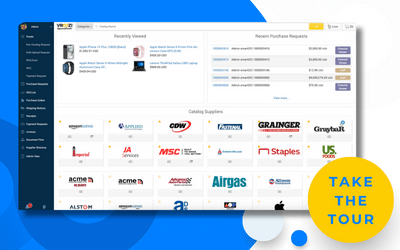
As business needs are identified and contracts are negotiated with vendors, creating a centralized supplier marketplace with hosted and punch-out catalogs makes it easy for employees to purchase the items they need. It can also streamline supplier management and improve supplier relationships through more streamlined workflows.
In this capacity, touchless procure-to-pay can automatically map employee-submitted information to central financial records, minimizing the need for the involvement of procurement teams. Marketplace development in touchless solutions can also control costs and ensure contract compliance by automatically driving employees toward purchases that align with company rules and policies.
Purchase Request and Purchase Requisition Development
Solutions like Vroozi can automatically generate purchase requisitions or purchase orders based on employee marketplace interactions, integrating company-specific pricing and reducing both paper processing and manual effort. Touchless procure-to-pay can also be customized with financial and sourcing rules that provide instant approvals in specific situations.
Invoice Management
Cloud-based electronic invoicing systems allow for a number of touchless capabilities, including:
- Invoice matching and error identification: Vroozi uses cognitive optical character recognition (OCR) to read and extract data from invoices, as well as two-way and three-way intelligent matching for both PO and non-PO invoices sent across multiple buying channels.
- Automatic invoice processing: Touchless procure-to-pay can automatically approve invoices according to an organization’s specified rulesets and tolerances if all vendor invoice fields match the corresponding purchase order or other guidance.
- Smart invoice coding: Machine learning (ML) systems can drive smart invoice coding and approval workflows, learning as they go to more accurately code invoices and route them for payment the longer they operate.
- Fraud detection: Touchless P2P can be configured to flag potentially fraudulent invoices based on cybersecurity detection engines. Since invoice and refund scams increased by 50% in Q1 2023 alone, automating this layer of protection is critically important.
- Automatic exception handling: When a vendor invoice deviates from expectations, touchless procure-to-pay can intelligently route them to the correct department to provide more control over review and resolution.
Purchase and Spending Analysis
Thanks to the multifaceted view of an organization’s spend touchless procure-to-pay software provides, purchase and spending analytics can be used to solve a number of common procurement challenges.
Take low spend under management as an example. With custom reports into every department’s purchasing patterns, touchless procure-to-pay software can provide the financial visibility needed to determine which spend categories are under-managed. Because this can indicate poor adoption or employees operating outside of the standard procurement workflow, automatically detecting these categories can create opportunities to improve efficiency without requiring manual detection.
Stronger purchase and spending analysis also drives better financial decision-making company-wide, as trends can be easily identified to forecast future needs. Because touchless P2P can operate automatically, historical performance can be interpreted instantly—no painstaking calculations required.

How Touchless Procure-to-Pay Ensures Contract Compliance
Another benefit of touchless procure-to-pay software—one that’s often underappreciated—is its ability to keep organizations in compliance with their negotiated contracts, automatically.
When contracts are managed manually using paper documentation, key pages can be misplaced—and once they’ve disappeared, they can’t be enforced. Further, relying on manual enforcement of contract terms puts a substantial burden on finance team members. Educating employees and reviewing every purchase requisition requires a substantial amount of time and still isn’t guaranteed to ensure policy compliance.
Alternatively, touchless procure-to-pay can automate purchasing contract compliance. For example, Vroozi’s supplier marketplace can be configured to guide buyers towards preferred contracts and vendors that support specific company initiatives. This requires no education on the buyer’s part and results in friction-free compliance.
Modernize Your Procurement Process
While modernizing your procure-to-pay process with touchless procure-to-pay software may sound appealing, it’s still important to do your due diligence as you determine which solution best suits your needs. With that in mind, here are a few tips we recommend you consider when procuring your new procurement solution:
- Consider your integration requirements: Do you use Oracle or SAP as an ERP system? Do you use NetSuite or Xero as your accounting software or accounts payable system? Whatever the case, it’s important to determine whether or not the procure-to-pay solution you’re considering integrates cleanly with your existing tech stack (or whether custom APIs and their associated costs will be required).
- Involve all necessary stakeholders: Ensure department heads and cross-functional stakeholders from all levels are represented in the touchless P2P evaluation process. Though major purchase decisions are often handled by the C-suite, having the input of front-line accounting employees is vitally important for ensuring future adoption. Learn how to build a business case for P2P automation.
- Arrange for a demo in a sandbox environment: Any reputable procure-to-pay provider should allow you to trial your company’s specific processes through a custom demo or a sandbox environment. Fully utilize your demo window by documenting key processes ahead of time so that you can see how they’ll be handled in each solution you’re considering.
- Look for mobile compatibility: Enabling users to carry out common activities on their mobile devices increases adoption by meeting them where they are. Don’t just take providers’ word on mobile compatibility—demo key mobile workflows yourself during your evaluation period to ensure true ease of use.
- Evaluate specialist technology integrations: No touchless P2P system truly does it all. If you anticipate integrating specialist technology solutions—such as Avalara, Veryfi, or Vertex—confirm that they can be easily connected to the platforms you’re evaluating.
- Estimate potential implementation times: A touchless procure-to-pay rollout shouldn’t disrupt your operations unnecessarily. Ideally, you should be able to get your new solution up and running within six weeks.
The decision to adopt a procure-to-pay solution—whether touchless or not—shouldn’t be undertaken lightly. Evaluate your options carefully as you prepare to enjoy the benefits of procure-to-pay process automation.
If it seems like Vroozi could be a good fit for your touchless procure-to-pay needs, we’d love to show you around. Reach out to book a demo or contact us with your questions.