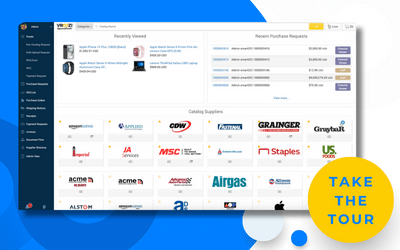
When managed through a single procurement platform like Vroozi, supplier catalog management improves contract compliance, spend visibility, and purchasing efficiency across the procurement function.
A supplier catalog management platform centralizes hosted catalogs, punchout catalogs, supplier content, contract pricing, and purchasing rules so buyers can find approved items more easily.
Does your supplier catalog management make your procurement team want to run in the other direction? Are you tired of employees buying from unapproved vendors just because finding the right one takes too long?
There is a solution. Centralizing supplier catalogs inside a single procurement platform, like Vroozi’s marketplace-first procurement software, helps resolve fragmented supplier catalog management issues that slow down your team.
Using a simplified combination of hosted catalogs, punchout catalogs, and supplier content in one controlled buying environment, Vroozi makes it easier for employees to find approved items and stay on contract. Ready to learn more?
What Is Supplier Catalog Management?
Supplier catalog management means organizing, standardizing, updating, and controlling supplier product and service information within a centralized procurement system.
A single, well-maintained supplier catalog makes it easy for employees to search, compare, and purchase from a single interface. Vroozi’s procurement software centralizes supplier data management into a marketplace-style buying experience that is both familiar and easy to use.
The best part is that procurement leaders gain stronger control over what’s available, what it costs, and who can buy it—all while strengthening supplier relationship management through consistent, accurate, and up-to-date catalog data.
How Do Disconnected Supplier Catalogs Create Procurement Problems?
Disconnected supplier catalogs produce inconsistent data, off-contract purchases, and poor spend visibility, resulting in low user adoption.
Working across multiple systems and supplier websites is confusing, and that confusion leads to:
- Duplicate and outdated records
- Off-contract buying
- Low user adoption
- Limited spend control
As if that weren’t enough, each of these issues increases manual work, erodes contract value, and reduces the reliability of your procurement data. Vroozi’s centralized catalog helps teams address these problems earlier in the buying process.
How Does a Single Procurement Platform Improve Catalog Control?
Yes! A single procurement platform, like Vroozi’s procure-to-pay platform, gives procurement leaders unified control over supplier content, contract pricing, catalog access, and purchasing behavior.
Vroozi’s marketplace-first platform brings everything together in one controlled buying environment.
Here’s what you can expect:
- Hosted Catalogs
- Unified catalog search
- Punchout catalog integration
- Real-time pricing and availability
- Centralized catalog
Rather than asking buyers to navigate multiple systems or memorize procurement rules, Vroozi’s catalog integration platform builds those rules directly into the purchasing experience, ensuring compliance, consistency, and control at every step.
How Does Standardized Supplier Data Improve Buying and Reporting?
Standardized supplier data improves search accuracy, eliminates duplicate records, and gives finance teams cleaner data for procurement reporting.
Procurement reports become more reliable when all information is consistent. This means ERP integrations—whether with SAP, Oracle, Microsoft Dynamics, or other major financial systems—receive cleaner transactional data, reducing reconciliation errors and manual cleanup.
Vroozi’s “snap-on” procurement layer is where users shop, compare, and buy. It then passes clean, structured transaction data back into the ERP system of record, without requiring a rip-and-replace of existing systems.
How Does Guided Buying Turn Catalog Management Into Spend Control?
Guided buying enables compliant purchases without friction, using catalog data, supplier rules, and approval workflows to keep procurement on track.
When supplier catalog management is done right, it shapes buying behavior. Vroozi’s guided buying capabilities use centralized catalog data to:
- Prioritize preferred suppliers and surface approved alternatives
- Trigger approval workflows when purchase thresholds are reached
- Enforce procurement policies on punchout catalog orders placed on external supplier sites
- Reduce manual oversight by embedding compliance into the buying experience itself
With Vroozi’s guided buying, every transaction is compliant, efficient, and cost-effective.
The main benefits of centralized supplier catalog management include easier supplier access, cleaner data, better contract pricing visibility, stronger buying controls, improved ERP data quality, and a simpler user experience.
Disconnected Catalogs vs. One Procurement Platform
| Area | Disconnected Supplier Catalogs | Centralized Procurement Platform with Vroozi |
|---|---|---|
| Supplier access | Spread across systems and supplier sites | Centralized in one marketplace |
| Data quality | Inconsistent and duplicated | Standardized and searchable |
| Contract pricing | Hard to find or verify | Visible at the point of purchase |
| Buying control | Reactive and manual | Guided and policy-driven |
| ERP data | More errors and cleanup | Cleaner, more consistent purchasing data |
| User experience | Frustrating and fragmented | Simple marketplace-style buying |
| Analytics | Limited visibility | Real-time catalog and spend visibility |
FAQ: Supplier Catalog Management
Q: What is supplier catalog management?
A: Supplier catalog management refers to organizing, standardizing, and maintaining supplier product and service data in a procurement system.
Q: What is the difference between hosted catalogs and punchout catalogs?
A: Hosted catalogs are supplier product lists stored directly inside the procurement platform, while punchout catalogs connect buyers to a supplier’s external catalog from within the approved purchasing workflow. Both help procurement teams centralize supplier content and guide buyers toward approved purchasing options.
Q: Why should procurement teams centralize supplier catalogs?
A: Centralizing supplier catalogs makes it easier for buyers to find approved products, use preferred suppliers, follow contract pricing, and stay compliant.
Q: How does centralizing supplier catalogs improve spend control?
A: Centralizing supplier catalogs improves spend control by guiding users toward approved suppliers and contracted items, while giving procurement teams better visibility into buying behavior.
Q: How does Vroozi support supplier catalog management?
A: Vroozi’s marketplace-first model supports supplier catalog management by offering stronger guided buying features, contract controls, and spend analytics.
Get It All in One Place With Vroozi’s Centralized Catalog
Great supplier catalog management becomes excellent procurement performance. If your team is struggling with fragmented supplier data, off-contract spending, poor reporting, or lost savings—or even a mix of all of these—a centralized procurement platform like Vroozi can help.
Schedule a personalized demo with Vroozi to see how it can transform your supplier catalog management.