A procurement team’s success is measured by its ability to secure the best deals—balancing cost savings, compliance, and supplier quality. It typically requires comparing dozens of suppliers based on multiple criteria—a tedious and time-consuming task. That’s where the RFx (Request for) process comes in. Whether you need general information (RFI), a price quote (RFQ), or a detailed proposal (RFP), selecting the right RFx process is essential for streamlining procurement and maximizing value.
This article explains when to use the three main RFx documents—RFI, RFQ, and RFP—and how they shape the procurement process.
Key Highlights
- RFx processes streamline procurement by helping teams gather vendor information and compare proposals to secure the best deals.
- RFI (Request for Information) is used for initial vendor research, assessing capabilities, and understanding market offerings.
- RFP (Request for Proposal) gathers detailed solutions from vendors, including implementation strategies and pricing models.
- RFQ (Request for Quotation) requests pricing and terms from multiple vendors for cost comparison.
- RFI is exploratory, RFP seeks tailored solutions, and RFQ signals a purchase intent. Each serves a distinct procurement stage.
- Vroozi automates RFQ management, simplifying bid tracking, notifications, and comparisons for faster, more efficient procurement.
What are RFI, RFQ, and RFP?
RFI, RFQ, and RFP are three key procurement tools used to engage vendors and gather critical information about their products, services, and business practices.
- Request for Information (RFI): Used to gather general details about a vendor’s products, services, capabilities, shipping times, company history, and other background information.
- Request for Proposal (RFP): Asks vendors to propose tailored solutions that address specific business needs or challenges.
- Request for Quotation (RFQ): Requests pricing and other purchasing details for specific products the company intends to buy.
They represent three different stages of the procurement process. Vendors are eliminated at every stage until one is chosen for the final item purchase.

Procurement process (Source)
RFI, RFP, RFQ in the procurement process
When evaluating new vendors, procurement teams typically begin with an RFI to assess whether the vendor meets credibility and trustworthiness criteria. If the vendor seems like a good fit, an RFP is issued to explore potential solutions and establish terms of engagement.
If the proposal is satisfactory, the vendor is approved as a qualified supplier. Employees can only purchase from these suppliers after receiving a quote (RFQ) or when a contract is in place. When making a purchase, employees will request pricing from multiple suppliers, generating RFQs to ensure competitiveness. For categories and products not yet sourced, companies often implement a ‘3 bids and a buy’ policy to facilitate a competitive bidding process.
RFI vs. RFP vs. RFQ: Key differences
All three documents are used to obtain information to vet and choose vendors; however, they are used at different stages of the buying process.
Intent
The intent behind an RFI is purely exploratory. It helps procurement teams assess potential vendors without committing to a purchase or formal negotiation.
An RFP indicates a more complex intent. The buyer is not just looking for pricing but also for a well-defined solution to a business challenge. The goal is to assess how vendors propose to address specific needs, including implementation strategies and long-term support.
An RFQ, on the other hand, signals a clear intent to buy. Companies issue RFQs when they have predefined requirements and need pricing and terms from multiple vendors to compare and select the most cost-effective option.
Buyer awareness
An RFI is used when the buyer is unaware of available solutions or vendors. At this stage, the company gathers information to understand the market, vendor capabilities/background, and general industry trends.
In contrast, an RFQ is issued when the buyer has a high level of awareness and already knows exactly what they need. The focus is on price, delivery terms, and supplier reliability.
An RFP falls somewhere in between. The buyer has a solid understanding of the problem but is looking for vendors with capabilities to meet their specific requirements.
Components
An RFI typically contains open-ended questions about a vendor’s background, product range, service capabilities, experience, and references. Since it is an initial inquiry, it does not include specific pricing or contractual details.
In contrast, an RFQ is highly structured and includes detailed product specifications, required quantities, payment terms, and shipping details. The response is expected to be straightforward, often in the form of a formal price quote.
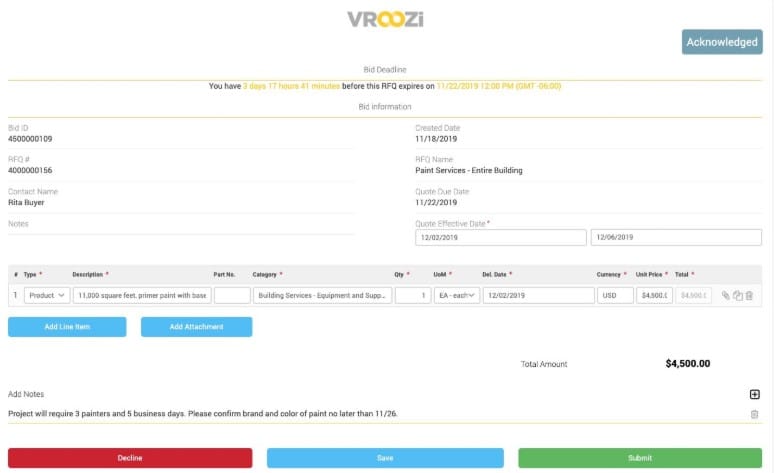
RFQ Example from Vroozi
An RFP is the most comprehensive, including a detailed scope of work, project requirements, evaluation criteria, pricing structure, and legal or compliance considerations. Vendors submit structured proposals addressing each requirement. They often include case studies, technical documentation, and cost breakdowns as part of their proposal.
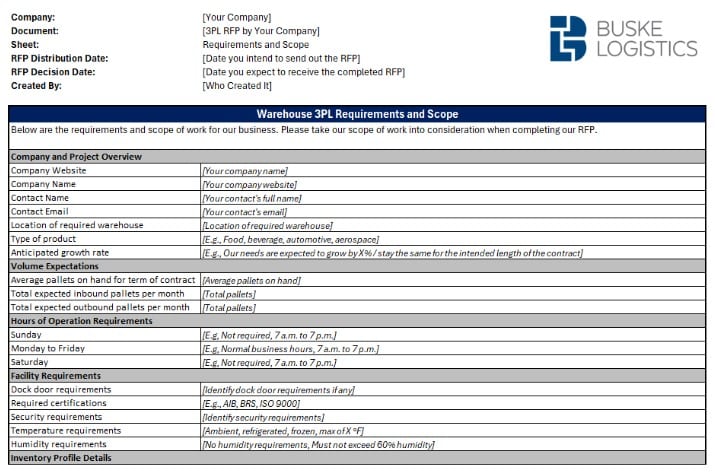
RFP example (Source)
Style
The writing style of an RFI is broad and open-ended. It invites vendors to provide general information and insights, often leaving room for subjective responses.
An RFP follows a formal and structured format but allows room for creative problem-solving. It often includes technical specifications, evaluation metrics, and industry-specific requirements.
An RFQ is purely transactional, written in a clear and concise manner, with little room for interpretation. It focuses on numbers, timelines, and contract terms.
Challenges in managing RFI vs. RFP vs. RFQ
Creating documents, communicating with vendors, and collecting data is time-consuming. Procurement officers must keep track of multiple communication threads, engage in meetings and discussions, and keep detailed records of requests and responses.
RFIs can result in vague or inconsistent responses, making it difficult to compare vendors effectively. Since vendors are not bidding on a specific project, they may provide broad or incomplete information. RFPs are the most time-consuming for both buyers and vendors. Creating a comprehensive RFP requires significant effort to ensure clarity. Due to variations in proposed solutions, evaluating multiple proposals becomes complex.
However, both RFI and RFP are one-time activities. Once the necessary information is gathered, vendors are evaluated, and the best options are integrated into the procurement system, no further action is needed until a reassessment.
RFQs, on the other hand, present an ongoing challenge due to their transactional nature. Each employee request triggers a new cycle where procurement officers must issue multiple RFQs, gather vendor bids, and conduct price comparisons. Managing this process involves continuous follow-ups, handling change requests, and tracking responses—often through emails—which adds significant communication overhead and administrative complexity.
Vroozi for RFQ management
Vroozi simplifies tactical sourcing by streamlining RFQ creation, bid tracking, and supplier communication. Buyers can quickly generate RFQs from item catalogs, compare responses side by side, and issue purchase orders directly from awarded bids—ensuring speed, compliance, and full visibility across the process.
- The buyer can select items and raise RFQs with just a few clicks.
- Both buyer and vendor get automatic notifications once the RFQ is created.
- The vendor can send a bid by clicking and entering data via email.
- Both get automatic reminders of approaching RFQ response deadlines.
- All bid data can be tracked centrally. You can see all submitted drafts and bids from a single dashboard.
- Bids can be compared side by side, awarded, or rejected with just a few clicks.
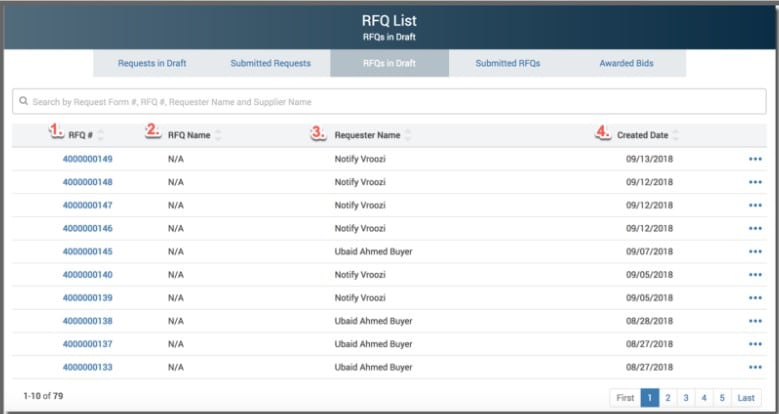
Centrally managed RFQ data in Vroozi

Bid comparison in Vroozi
RFI vs. RFP vs. RFQ: Summary of differences
| Criteria | RFI | RFP | RFQ |
| Full form | Request for Information | Request for Proposal | Request for Quotation |
| What is it | A preliminary inquiry to gather information about potential vendors, their capabilities, and offerings. | A detailed request asking vendors to propose solutions to a business challenge. | A formal request for pricing and terms for specific products or services. |
| Intent | To gather general information about vendors, their offerings, and capabilities. | To evaluate proposed solutions and select the best vendor for a project or service. | To obtain price quotes and terms for a specific product or service. |
| Buyer awareness | Low – The buyer is in the early research stage and exploring available options. | Medium to High – The buyer understands their needs but seeks vendor expertise on implementation. | High – The buyer knows exactly what they need and is focused on price and terms |
| Components | Open-ended questions about company background, product range, service capabilities, past experience, and references. | Detailed scope of work, project requirements, evaluation criteria, pricing structure, and proposal guidelines. | Itemized requests for pricing, quantity, lead times, and other purchasing terms. |
| Style | Informal and broad; focuses on gathering data rather than making decisions. | Highly structured and transactional, focused on numbers and specifics | Formal, detailed, and often includes technical or industry-specific requirements. |
| When to use | When exploring potential suppliers and solutions before making a decision. | When the buyer has a business need but wants vendors to propose the best solution. | When the exact product, quantity, and specifications are known, a price comparison is needed. |
Frequently Asked Questions
What is RFP vs. RFI vs. RFx?
An RFI gathers general information about a vendor’s offerings and capabilities. An RFP is used when a company needs detailed proposals to address specific business challenges or requirements. RFx refers to the general category of requests, including RFI, RFP, and RFQ (Request for Quotation). Other RFs include RFIs (Request for Input), RFDs (Request for Decision), and RFTs (Request for Tender), which are used to gather input in different industries.
What is vendor RFQ?
A vendor RFQ is a procurement document used to request detailed pricing and terms for specific products or services. Unlike an RFP, which seeks solutions, an RFQ focuses on gathering pricing and delivery details from multiple vendors, enabling buyers to compare offers and select the best deal. Vendors respond with quotes that include price, quantity, delivery timelines, and payment terms for the requested items.
How do I send the RFQ to the vendor?
To send an RFQ (Request for Quotation) through Vroozi’s system, buyers can select the required items from their catalog and raise an RFQ in just a few clicks. Vroozi automatically notifies both the buyer and the vendor once the RFQ is created. Vendors can submit their bids directly through the system, and both parties receive automatic reminders for approaching deadlines. The system also allows for easy tracking and bid comparison, simplifying the decision-making process.
Which comes first, RFI or RFP?
An RFI typically comes first in the procurement process. It is used to gather general information about potential vendors, their capabilities, and products. After assessing the responses to the RFI, companies may proceed with an RFP, which is a more formal request asking vendors to propose tailored solutions to specific business needs based on the information gathered in the RFI.
What is the difference between RFC and RFP?
An RFC (Request for Change) is typically used in IT and project management to request modifications or improvements to existing systems or processes. In contrast, an RFP (Request for Proposal) is a procurement tool that solicits detailed proposals from vendors to address specific business needs. RFC focuses on changes or updates, while an RFP involves sourcing solutions from vendors for new projects or requirements.
Managing RFQs with Vroozi reduces administrative burden, accelerates decision-making, and supports stronger supplier relationships—all while helping you capture cost savings faster.
Ready to streamline your tactical sourcing process? Schedule a demo.