Procurement should drive cost savings, efficiency, and strategic value, but achieving these procurement objectives can be challenging and time-consuming, especially for organizations using SAP ECC.
SAP ECC is a robust enterprise resource planning system, but its procurement capabilities may not meet the evolving needs of a modern business. That’s where SAP ECC extensions come into play, offering powerful tools to streamline and simplify procurement processes.
This article will explore how SAP ECC procurement solutions help businesses overcome procurement challenges and achieve better outcomes. We’ll look at six key areas where extensions can make a difference, from digital marketplaces and catalog management to sustainable digital procurement and low-friction migration to SAP S/4HANA.
What Are SAP ECC Extensions?
SAP ECC provides a central platform for business data management and process orchestration. It supports and integrates various organizational business processes, including procurement, finance, human resources, sales and distribution, and supply chain management.
However, while SAP ECC enables data integration, it is a complex system that demands extensive training. Employees often struggle to fully understand and utilize its capabilities, leading to inefficiencies and errors. The complexity of its user interface and the need for specialized knowledge can hinder productivity and result in longer onboarding times.
Additionally, the steep learning curve gives rise to user resistance, complicating the implementation process and reducing user adoption.
SAP ECC extensions are software components that integrate with SAP ECC to extend its capabilities and address specific business needs. A procure-to-pay (P2P) solution like Vroozi uses SAP extensions to expedite and automate the entire procurement process, from requisition to invoice processing and payment, while ensuring that all spend data is available to SAP ECC.
SAP has announced SAP ECC’s retirement, with support ending in 2027. Its successor is SAP S/4HANA, a more modern SAP ERP solution built on the SAP HANA in-memory database. Organizations currently using SAP ECC should be planning their migration to SAP S/4HANA. As you’ll discover later in the article, SAP extensions, including SAP-integrated procure-to-pay software like Vroozi, can help businesses minimize the inevitable migration disruption.
How SAP Procurement Extensions Modernize SAP ECC Procurement
A SAP procure-to-pay extension transforms procurement for SAP ECC users. By integrating procurement with SAP ECC, extensions can provide improved efficiency, cost savings, and enhanced user experiences.
1. Digital Marketplaces and Catalog Management
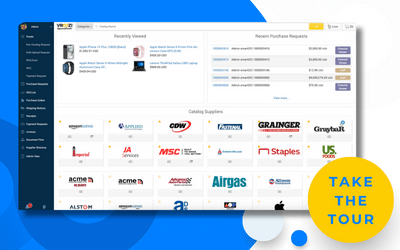
One of the primary advantages of integrating your SAP ERP with a procure-to-pay platform is an e-commerce-like digital marketplace. The marketplace incorporates supplier catalogs and allows employees to easily find and purchase goods and services with a consumer shopping experience.
Catalog management tools allow suppliers and procurement departments to maintain accurate and up-to-date product information, pricing, and supplier details. Supplier marketplaces include features such as:
- Centralized catalogs from approved suppliers
- Powerful search and filtering capabilities
- Side-by-side product comparisons
- Guided buying based on customizable procurement policies
2. Automating Procurement and AP Processes
Procure-to-pay platforms automate various procurement and accounts payable tasks, accelerating workflows and reducing the need for manual intervention.
- Users can create purchase requisitions directly in the digital marketplace. They are automatically routed for approval based on predefined business rules. Once approved, the purchase requisition is converted into a purchase order and sent electronically to suppliers.
- Suppliers can submit invoices electronically. The system automatically extracts invoice data and matches it against the corresponding purchase orders and receipts. Any discrepancies are flagged for manual review, while matched invoices are posted for payment.
- Multi-level approval workflows ensure the appropriate stakeholders review and approve requisitions and invoices. Approvals are based on delegation of authority, with flows based on organizational and accounting elements.
SAP procurement automation reduces cycle times, minimizes errors, and frees procurement professionals to focus on more strategic procurement activities.
3. Enhancing User Experience and Adoption
User adoption is fundamental to the success of any procurement system. Many organizations using SAP ECC face challenges in this area, resulting in low adoption rates and increased errors.
P2P software addresses these issues by providing an easy-to-use interface that simplifies purchasing. Guided buying ensures employees follow procurement policies, purchase approved products from contracted suppliers, and make fewer mistakes. Employees can access the system from their smartphones or tablets, anywhere and anytime, allowing them to create and approve purchase requests on the go.
By offering a more user-friendly and accessible procurement process, companies can achieve higher adoption rates and improved spend control.
4. Cost Savings and Spend Management
Procure-to-pay reduces costs by providing enhanced visibility into spend data and providing the insight you need to achieve strategic procurement objectives.
Detailed spend analytics offer insights that help identify consolidation, negotiation, and cost optimization opportunities. By tracking key metrics such as on-time delivery, quality, and price competitiveness, businesses can allocate more spend to top-performing suppliers and address underperformers.
A unified, automated, and compliant procurement process enhances the volume and quality of spend data, facilitating demand aggregation and consolidated spending. The procurement organization can leverage spend volume to negotiate better prices and terms with suppliers.
5. Sustainable Procurement
Sustainability has become a major focus for many organizations. Procurement plays a key role in driving sustainable practices, and procure-to-pay software like Vroozi helps businesses achieve their sustainability and ESG objectives.
Most importantly, it provides control and comprehensive visibility, allowing businesses to channel purchases to sustainable suppliers and verify employees adhere to sustainable purchasing policies.
Read more about procure-to-pay software and sustainable procurement.
6. Disruption-Free Migration to SAP S/4HANA
With SAP ECC nearing its end of life in 2027, many organizations are planning their migration to SAP S/4HANA. The transition is likely to be disruptive for even the best-prepared businesses. SAP S/4HANA’s technical underpinnings are radically different from those of ECC, and businesses will need to migrate databases to HANA, rewrite program code, and so on.
However, migration will involve more than technical changes. As SAP makes clear, successful migration to SAP S/4HANA also demands wide-ranging process changes.
Process-oriented changes include:
designing your new changed business process, configuring necessary measures, training users, assigning roles and authorizations, pilot operation, and converting the production system.
A SAP procurement extension can play a valuable role in bridging procurement processes before, during, and after migration. You can ensure a smooth transition and minimize expensive disruptions to daily business operations with:
- SAP Integration: A procurement solution that integrates with SAP ECC and SAP S/4HANA allows businesses to continue using best practices and their data during the migration, minimizing disruptions to operations.
- Incremental Migration: By decoupling procurement processes from the core ERP system, P2P procurement extensions enable businesses to migrate their procurement functions to SAP S/4HANA incrementally, reducing the risk and complexity of a full-scale migration.
- Future-Proofing: P2P extensions built on modern, cloud-based architectures are well-positioned to support SAP S/4HANA’s advanced capabilities, such as real-time analytics, artificial intelligence, and machine learning.
How Vroozi Simplifies SAP ECC Procurement
Vroozi, a leading procure-to-pay platform, offers a comprehensive suite of SAP ECC extensions to simplify and streamline procurement processes. Some key benefits of Vroozi’s solution include:
- SAP ECC and SAP S/4HANA Integration: Vroozi integrates with SAP ECC and SAP S/4HANA, enabling businesses to leverage their investment in the SAP ecosystem while enhancing procurement capabilities.
- User-Friendly Interface: Vroozi provides a modern, intuitive user interface that simplifies the purchasing process, driving high adoption rates and user satisfaction.
- Extensive Automation: Vroozi offers powerful automation capabilities spanning the entire purchasing, eProcurement, and accounts payable cycle, helping businesses reduce manual effort, minimize errors, and accelerate processing times.
- Supplier Collaboration: Strengthen supplier relationships and optimize supplier management by integrating static and e-commerce punchout catalogs with your digital marketplace. Buyers and suppliers collaborate via Vroozi’s supplier portal.
- Robust Analytics: Advanced spend analytics and reporting tools provide deep insights into procurement performance, enabling data-driven decision-making and continuous improvement.
- S/4HANA Readiness: Vroozi’s cloud-based architecture and integration with SAP ECC and SAP S/4HANA make it an ideal choice for businesses planning their migration to the next-generation ERP system.
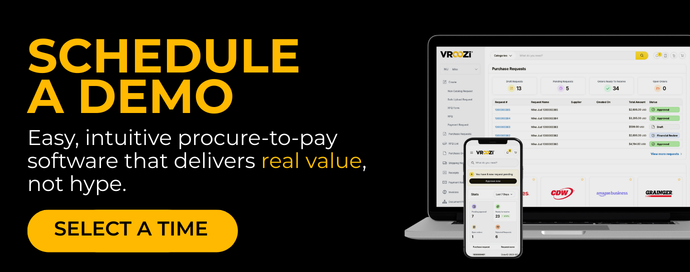
To learn more, experience a live version of the app or request a personalized walkthrough from one of our team members.