Businesses often struggle with disjointed and disconnected procurement. 82% of procurement leaders admit that indirect procurement is poorly managed, with inadequate collaboration and a lack of connection between systems and stakeholders. A similar proportion doubts the accuracy of spend data, preventing strategic decisions based on real-world information.
Many factors contribute to poor procurement performance. Workflows may be fragmented and siloed, with limited visibility and communication between departments and stakeholders. Manual processes, disparate systems, and lack of automation lead to errors, delays, and increased costs. Disjointed and suboptimal systems fail to deliver the desired business outcomes, and insufficient data and insights hamper decision-making.
Procurement orchestration is a modern approach to overcoming these problems. It coordinates and integrates the workflows, systems, and people involved in procurement operations. The objective is to create a cohesive and integrated system where the entire procurement lifecycle, from sourcing to payment, is carried out in a coherent manner, with information flowing smoothly between tasks and participants.
In this article, we explore:
- The components of procurement orchestration systems
- How orchestration solves procurement issues
- Signs procurement orchestration is right for your business
- How cloud-based procurement solutions empower businesses to take control of procurement processes
The Key Components of Procurement Orchestration
Successful procurement integration depends on two main components. The first is best-in-class software solutions for each stage in the procurement process. The second is seamless integration between those components, enabling data sharing, collaboration, automation, and significant cost savings.
Supplier Marketplace with Purchase Request Automation
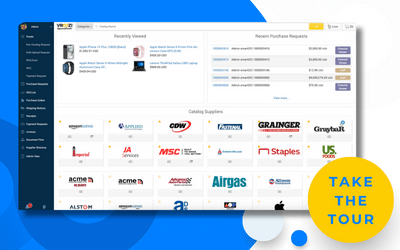
The procurement intake phase involves receiving and handling requests for goods or services. A supplier marketplace with integrated catalogs enables employees to easily find and select the products they need from approved vendors. The self-service buying process, combined with automated purchase requisition creation and approval workflows, streamlines the intake process and reduces the workload on your procurement team.
Purchase Order Automation
Once a purchase requisition is approved, the next step is to create a purchase order (PO) and send it to the supplier. Procurement orchestration solutions automate this process by generating electronic POs based on predefined templates and business rules. They also facilitate PO approval workflows, ensuring appropriate individuals review and authorize all orders where needed.
Workflow Automation
Workflow automation tools allow organizations to design, configure, and automate workflows based on their specific business rules and approval hierarchies. Tasks can be assigned, tracked, and escalated automatically, with notifications and reminders sent to relevant parties at each process stage. Automation ensures that procurement activities are completed efficiently and comply with organizational policies.
Accounts Payable Invoice Automation
Procurement orchestration extends beyond purchasing to encompass the entire procure-to-pay cycle, including invoice management and payment. Accounts payable invoice automation features, such as electronic invoice capture, data extraction, and three-way matching (PO, receipt, and invoice), help streamline invoice management. These tools also support automated approval routing and exception handling, ensuring that invoices are processed accurately and payments are made on time.
Integration Capabilities
To truly orchestrate procurement workflows, it is essential to integrate the various systems and tools involved in the procurement lifecycle. Procurement orchestration platforms offer a range of integration capabilities, including APIs, connectors, and pre-built integrations with popular enterprise systems such as ERP, inventory management, warehouse management, tax calculation, CRM , and accounting software. Integration enables real-time data synchronization across platforms, eliminating data silos and ensuring that employees can access to accurate and up-to-date information.
Benefits of Procurement Orchestration
Improved Efficiency and Productivity
Integration and automation improve efficiency and productivity across the organization. They reduce the time and effort spent on manual tasks like data entry and document processing, free employees to focus on more strategic and value-added activities. Automated workflows and approvals also help accelerate procurement cycles, reducing lead times and enabling faster fulfillment of business requirements.
Cost Savings
Procurement orchestration can deliver substantial cost savings to organizations in several ways. First, by automating manual processes, it reduces the need for human intervention and the associated labor costs. Second, spend analytics and supplier performance management enable procurement teams to identify cost-saving opportunities, negotiate better prices, and optimize their supplier base. Finally, improving compliance and reducing maverick spending helps organizations avoid unnecessary expenses and maximize the value of their procurement spend.
Enhanced Accuracy and Reduced Errors
Errors lead to delays, rework, and financial losses. Manual procurement processes result in errors like data entry mistakes, miscalculations, and omissions. Procurement orchestration minimizes these risks by automating key tasks and enforcing data validation and business rules. Electronic document handling, for example, ensures that data is accurately captured and processed, while automated three-way matching helps identify and resolve discrepancies between orders, receipts, and invoices.
Increased Visibility and Control
Procurement orchestration gives organizations real-time visibility into their procurement activities, spending, and supplier performance. Dashboards and reporting tools empower teams to monitor key metrics, track progress against goals, and identify areas for improvement. This enhanced visibility also facilitates better budgeting, forecasting, and decision-making, as managers can access accurate and timely data on procurement spend and trends.
Improved Compliance and Risk Management
Orchestration helps organizations comply with negotiated supplier contracts, internal policies, industry regulations, and legal requirements. Automated workflows and approvals enforce purchasing policies and thresholds, reducing the risk of unauthorized or non-compliant spend. Electronic documentation and audit trails provide evidence of compliance and facilitate internal and external audits.
Does Your Organization Need Procurement Orchestration?
While procurement orchestration offers numerous benefits, not all organizations need a full-fledged orchestration solution. However, if your company experiences the following challenges, it may be time to consider orchestration.
Rogue Spending
Rogue spending, also known as maverick spending or off-contract spending, is buying that happens outside of approved supplier contracts. It occurs due to low employee adoption of procurement systems, a lack of centralized procurement policies, limited spending visibility, or employees’ preference for certain suppliers. Rogue spending can lead to higher costs, reduced negotiation leverage, and increased risk of non-compliance.
Procurement orchestration addresses the rogue spending issues by:
- Increasing employee adoption of the procurement system
- Providing a centralized marketplace
catalogof approved suppliers - Enforcing purchasing policies
- Monitoring spend across the organization
Inadequate Spend Visibility
Spend visibility is the ability to track, analyze, and report on an organization’s spending data. Organizations struggle to make informed decisions, identify savings opportunities, and optimize their procurement strategies without clear visibility into spending patterns, supplier performance, and contract compliance.
Signs of poor spend visibility include difficulty in answering basic questions about spend, inconsistent data across different systems, and a lack of real-time reporting capabilities.
Procurement orchestration improves spend visibility by:
- Increasing employee adoption
- Eliminating error-prone manual processes
- Consolidating procurement data on a single platform for predictive procurement orchestration
- Providing advanced analytics tools and generating user-friendly dashboards and reports
Purchasing and Invoicing Errors
Issues such as incorrect purchase orders, mismatched invoices, and delayed payments can strain supplier relationships, cause financial losses, and create operational inefficiencies. Manual data entry, lack of standardization, and inadequate controls are common causes of purchasing and invoicing errors.
Procurement orchestration minimizes errors by:
- Automating key tasks
- Enforcing data validation standards and processes
- Connecting purchasing and AP invoicing
- Leveraging machine learning for automatic data capture, order matching, coding, and fraud detection
Excessively Long Purchase Cycles
The purchase cycle, or the time it takes from requisition to receipt of goods or services, is a critical metric for procurement performance. Excessively long purchase cycles can delay projects, impact operational efficiency, and frustrate internal stakeholders and suppliers.
Manual processes, complex approval workflows, and a lack of department collaboration contribute to lengthy purchase cycles.
Procurement orchestration streamlines the purchase cycle by:
- Automation of requisition, purchase order, and approval process
- Enabling touchless procure-to-pay
- Providing real-time visibility into the status of orders and approvals
- Digitizing and centralizing procurement documents for easy access and reference
- Providing mobile apps and notifications to enable approvals and decision-making on the go
Overcome Procurement Challenges with Vroozi Procure-to-Pay
Vroozi is a complete procure-to-pay solution to help your organization connect, streamline, and automate its procurement and AP invoice management.
- An intuitive digital marketplace and supplier portal
- Custom approval workflows
- Procure-to-pay automation
- eProcurement and accounts payable invoice automation
- Powerful spend analytics and reporting
- Digital payments
To see Vroozi in action, experience a live version of the app or request a personalized walkthrough from one of our team members.