Improving your Source-to-Pay (S2P) process can pay off big time. McKinsey found that businesses that take steps to manage indirect spending (items that support general operations) can shave as much as 15% off their annual spend.
S2P covers and streamlines all categories of payments – both direct and indirect spend.
- Direct spend is for items and services that go directly into the product, such as raw materials, components, packaging, and energy costs.
- Indirect spend is for extra costs, such as office supplies or software subscriptions.
The basic Source-to-Pay flow is pretty simple. It includes the whole spending process – analytics, sourcing, contracts, procurement, and finance. S2P groups it all into one cohesive strategy using multiple specialized systems and tools.
But there’s more to it than that, especially now AI and advanced automation tech are reshaping how it works.
That’s why we’ve put together this guide to help you implement effective S2P processes. We’ll discuss how to identify exactly what your business needs, when you need it, and how to find the best suppliers to meet those needs.
What is Source-to-Pay (S2P)?
A source-to-pay process or strategy pinpoints the goods and services your business needs for day-to-day running throughout the supply chain. But it goes beyond simply buying things by planning how to get these goods and services in a way that creates competitive and strategic advantages for your company.
Using a P2P strategy, you figure out what goods and services are needed, compare suppliers, negotiate prices, and make sure everything you buy is of the highest quality, while still meeting your budget. This delivers value that extends beyond cost savings by giving you a real edge over competitors.
Good source-to-pay systems save you time and money by automating elements of the process. This eliminates the back-and-forth exchange with suppliers. You can also set up tools that automatically handle the payments on time, keeping your suppliers happy and freeing up your time.
Once you’ve ordered the goods or services, your P2P system keeps an eye on the orders. You should have checks in place to ensure everything you buy arrives on time and matches what you ordered so there are no surprises.
How Does Source-to-Pay Work?
It’s best to think of source-to-pay as both a system and a strategy.
As a strategy, S2P involves striking the right balance between affordability and long-term value. Balance is reached by following steps that efficiently manage procurement with a focus on minimizing costs and weighing up aspects such as supplier reliability and quality.
It’s about creating value through strategic sourcing and realizing it during operational processes. S2P also helps you develop stronger supplier relationships, set procurement guidelines, and continuously improve based on data insights.
As a system, S2P refers to the platforms and management tools used throughout the procurement process from initial sourcing to paying your suppliers. It usually involves integrative software that partially automates various procurement functions such as spend analysis, supplier management, contract management, and invoice processing.
First, let’s look at the strategic side of source-to-pay by breaking it down into a series of six steps.
1. Identify Opportunities Through Spend Analysis
The first step is to carry out a complete and thorough spend analysis. This means looking at all your current spend and transactions to see what you’re buying, who you’re buying it from, and at what cost. This helps you spot opportunities to save money or renegotiate terms.
You can use the results of the spend analysis to understand exactly what your business needs and adjust to suit. For instance, you might identify that you are buying the same product from multiple suppliers and that you are paying multiple prices for the same product. The solution is to look for better deals from leverage. Spend analysis is an ongoing process that needs to be reviewed continuously.
2. Select and Manage Your Suppliers
Start by keeping a detailed record of all your current suppliers and focus on how well they meet your needs in terms of price, quality, and reliability. For new suppliers, take the time to set clear criteria that define the qualities you’re looking for in a supplier.
Then, request proposals and quotes from a wide variety of potential suppliers. Compare the quotes through a lens of dimensions that are important to the business, bearing in mind that the cheapest option isn’t necessarily the best. Sometimes, it’s worth paying more for a supplier that offers superior quality and consistency, and contributes to brand quality and value generation.
3. Qualify Suppliers and Negotiate Contracts
Once you’ve reviewed the proposals, compare detailed bids. This means outlining your terms, conditions, and requirements.
After receiving bids, you can narrow it down to a single supplier based on how well the supplier meets your financial and business requirements. Sit down with the chosen supplier and go through everything – prices, delivery schedules, and any other terms. Once you’ve agreed on terms, you can finalize the contract.
4. Procure Goods and Services
After you sign the contract and it’s all official, you start the actual procurement process. This means you begin ordering the goods and services you negotiated and realize the lower contract pricing or discounts, for instance.
Once the supplier contract is signed, the next step is to start placing orders while realizing the benefits of strategic sourcing. If employees aren’t aware of the terms or pricing, they might accidentally go off-contract, so it’s important to keep them informed and aware of compliance.
When everyone follows the plan and sticks to the agreed pricing and terms, you save money and reinforce the benefits of all the negotiating and sourcing you’ve already done.
Additionally, you should collaborate with suppliers to ensure deliveries match exactly what is needed and expected. This reduces discrepancies and streamlines operations.
5. Receive Goods and Confirm Services
When the goods arrive, you need to check the delivered items against your purchase order. Inspect the delivery to make sure the numbers match. You should also ensure all other contractual terms are met, such as quality, delivery times, and safety compliance. You should also set up an effective returns process, so that you only pay that accurately reflect what is received and kept, preventing overpayments or discrepancies.
If there’s a discrepancy, don’t wait. Aim to address it immediately by documenting the issues, e.g. a missing item or a quality problem, and notify the supplier. The faster you act, the more likely it is that you’ll resolve the issue quickly.
6. Settle Payments
Once all the goods and services are received and you’ve verified that everything is as it should be, the process transitions to accounts payable (AP).
AP makes sure you only pay for goods and services received, confirmed, and expected, and that the payment is made to legitimate suppliers. Only after this critical invoice validation is completed are payments processed according to the agreed terms.
Aim to pay your suppliers on time, as it maintains good relationships and puts you in a favorable position for future negotiations. It also strengthens your reputation as a reliable business partner.
How AI & Automation Tools Enhance Source-to-Pay
Analyze Vast Datasets
You can use AI tools to analyze large datasets very quickly. The machine learning models will find spending trends and anomalies that might not otherwise be apparent. This can also help you detect fraud by spotting irregularities in real-time. You can then take corrective action before they escalate.
For instance, you can use a platform that automates elements of spend analysis, to generate deep insights into procurement patterns and suggest actions that reduce costs. Using this kind of platform gives you real-time visibility into sourcing and procurement, as well as built-in KPI monitoring.

Select Suppliers with Confidence
With the right source-to-pay or procure-to-pay platform in place, you get a 360-degree view of supplier performance and spend. You can use this to evaluate suppliers based on delivery, quality, and compliance. This accelerates qualification, getting you to the contract stage more quickly.
Smarter Spending with AI
AI can help you identify compliant sources of supply. Instead of manually checking if a supplier meets your standards, the system saves time by flagging up the best options for you. It can also help employees continue buying with approved and preferred suppliers.
AI also analyzes buying trends. Let’s say your team keeps running out of a certain material, you might not notice the pattern until it’s too late. AI can spot that trend early and prompt you to reorder before you hit a bottleneck.
One of the big things AI does is cognitive scan and capture. It can pull data from invoices automatically without the need for manual data entry. Then it codes non-PO invoices, checks for duplicates, and matches orders to invoices. It also keeps your accounting more accurate by catching discrepancies before they turn into problems.
Capturing all the spend data from invoices gives you complete visibility into your spending. It’s great for compliance, catching fraud, and making smarter decisions about where your money’s going.
Streamline Your Sourcing & Procurement
Source-to-Pay is more than just a process. It’s a strategy and system that includes policies and tools for managing the entire sourcing and procurement process.
The AI revolution is making it easier than ever to automate many time-consuming procurement activities, such as spend analysis, supplier qualification, invoicing, and payment.
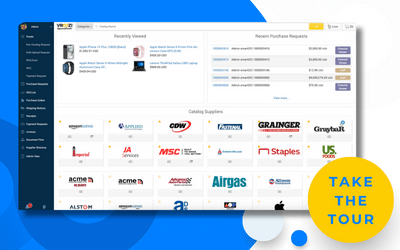
Vroozi is an AI-powered spend management platform that supercharges your procurement processes. You can manage all your corporate spend and invoicing in the platform, as well as access a large e-procurement marketplace to find the best suppliers.
Book a demo to find out more.