Merely uttering “purchasing” and “procurement” in the same breath can spark controversy in the office. The two terms are often used interchangeably, but there are distinct differences between these two equally important job duties.
Knowing the differences between purchasing versus procurement is the first step in mapping out a plan to improve your organization’s entire procure-to-pay (P2P) pipeline. In this article, we examine the differences between purchasing and procurement and look at ways to improve both.
Purchasing vs. Procurement: How Are They Different?
Although both purchasing and procurement deal with transactions, their roles are separate. Purchasing tends to be a tactical role in which you need to react to and solve payment-related issues daily. Simply put, purchasing is tasked with buying products and managing purchases.
Alternatively, procurement holds a strategic role. If you’re in charge of procurement, you need to see how the organization spends money and build a plan to stretch budgets further. That might include negotiating with suppliers, securing discounts, building supply chain resilience, or tackling other big-picture duties.
Common Purchasing Responsibilities
Wondering what a typical job in purchasing looks like? Here are a few common responsibilities that purchasing professionals need to accomplish:
- Tracking down purchase requisitions
- Soliciting bids
- Handling purchase orders (POs)
Although this is just a short list of possible jobs purchasing could be in charge of, they all take a tactical shape. To be successful, purchasing needs efficient processes that push orders through quickly and with as little manual input from their team as possible. After all, if purchasing has to roam the hallways for approvals, it could delay payments.
Common Procurement Responsibilities
Procurement is in charge of a completely different set of responsibilities. Some examples include:
- Evaluating and understanding the organization’s product and service needs
- Creating a strategy to lower costs or reach financial goals
- Building supplier relationships
- Negotiating deals with suppliers
- Agreeing on terms
- Managing spend
- Navigating supply chain challenges
Unlike purchasing, procurement can’t afford to be reactive. Instead, this group thrives when they have clear spend visibility and can rely on accurate numbers. If P2P processes aren’t sound, procurement can waste time on tasks rather than strategy, holding back the entire operation.

How to Improve Work for Both Procurement and Purchasing
Even though procurement and purchasing take on different shapes, they’re intertwined–and they keep the whole procurement operation running. You need purchasing to process transactions, but purchasing also feeds off direction from procurement functions to know which approved suppliers to work with and what deals to take advantage of.
At the same time, if purchasing isn’t inputting accurate data into your digital or enterprise resource planning (ERP) systems, it can cloud procurement’s spend visibility and disrupt leaders’ abilities to make smart strategic decisions.
With that interplay between procurement and purchasing in mind, here are a few ways to boost productivity through both functions:
Digitize the full P2P process.
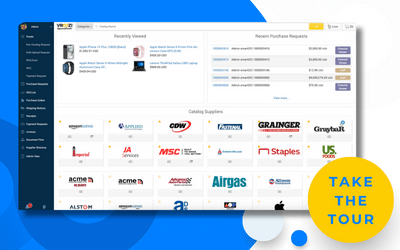
One of the easiest ways to improve both procurement and purchasing is by adopting a fully digital P2P process. An advanced P2P platform will provide a centralized marketplace in which employees can make purchases with approved suppliers. That means spend data flows directly into your digital system, where procurement can see the detailed reports they need to build and execute their strategy.
Lean on AI.
Artificial intelligence (AI) can speed up payment processes, reduce errors, and simplify work for both procurement and purchasing. For instance, AI can help users code purchase requests with categories, organize accounting, and gather more accurate spend data. In turn, clearer spend data allows procurement to see everything they need to make smarter decisions.
Learn More Ways to Sharpen P2P Efficiency
Understanding the differences between procurement and purchasing is step one in boosting the organization’s procure-to-pay processes. Interested in learning about what you can do to improve your company even more? Read Spend Matters: The Evolution of Corporate Procurement Systems to learn how P2P systems have changed and what the latest technology can do to sharpen procurement and purchasing at your company.