Poor planning often results in disappointed customers and extra costs that can greatly hurt your profit margins. Overstocked inventory leads to higher storage costs and excessive waste. Understocking means customers can’t place orders when they need to, and your business misses out on critical sales opportunities.
The good news is that both of these risks can be largely mitigated with effective supply chain forecasting.
In this guide, we’ll walk through the definition of forecasting in supply chain management, why it’s crucial for effective strategic planning, and the 12 forecasting methods you can use to predict future demand.
What is forecasting in supply chain management?
Forecasting in supply chain management is the process of predicting future sales demand, inventory requirements, and pricing trends. It uses various inputs such as historical data, statistical models, market analyses, and expert opinions to enable businesses to make the best decisions during strategic planning sessions.
The importance of forecasting in supply chain operations
A business that can accurately predict supply and demand for a product is better positioned to capitalize on sales and maximize profit in the forecast period.
Supply chain forecasting affects the efficiency of multiple roles in an organization. Effective forecasting means better inventory management, an improved customer experience, and reduced risk of profit-killing challenges such as overstocked inventory or inflated operational costs.
As Ketan Anand, Chief Product Officer at Suuchi Inc., recently put it:
“Running a successful business demands an efficient supply chain that is major in specifying overall profitability. Moreover, it is a known fact that a broken supply chain slows down a company’s growth and destroys it over time.”
Ketan makes a strong point: when you understand how much inventory you’ll need (and when to purchase it) to meet demand, your business can benefit from cost savings across the board.
For example, efficient supply chain forecasting enables companies to optimize pricing strategies and correctly plan for labor and transportation needs ahead of a new product launch. It also facilitates cost-effective production planning strategies that ensure procurement of raw materials and components meets manufacturing requirements while minimizing excess inventory.
Supply chain forecasting methods explained
Most supply chain forecasting methods can be classified as either quantitative or qualitative.
Quantitative methods use statistical models and mathematical data to forecast future demand. For example, you could leverage historical spend analytics using Vroozi’s sophisticated procure-to-pay software to predict how much you’re likely to spend on inventory in a forecast period.
Qualitative methods rely on human judgment, market research, and opinions to make predictions. This can involve speaking directly to customers and industry experts to intuit how sales might look for an unreleased product or in an emerging market.
Here’s a quick breakdown of the key differences between these two categories:
| Quantitative | Qualitative | |
| Forecast inputs | Historical data, software analytics, and statistical models | Expert opinions, market research, and customer insights |
| Common examples |
|
|
| Pros |
|
|
Types of supply chain forecasting methods
Quantitative supply chain forecasting methods:
- Exponential smoothing. This method uses historical averages, weighted towards recent events to account for seasonality and short-term fluctuations. It’s particularly useful for making swift short-term predictions about sales demand.
- Adaptive smoothing. Similar to exponential smoothing, this forecasting method uses machine learning to adapt to changes based on the accuracy of previous forecasts. It results in more accurate predictions over time, making it ideal for dealing with trend shifts and inconsistent demand patterns.
- Moving average. This method predicts demand for one forecast period using the average of a previous period. It averages out the impacts of irregular variations in data and is easy to implement: a useful method for unlocking short-term inventory and production planning stability.
- Autoregressive Integrated Moving Average (ARIMA). A more complex variation on the moving average method, ARIMA captures trends, random fluctuations, and seasonality in historical data. While it requires statistical expertise and sufficient data to identify patterns, it’s a more effective forecasting method for predicting medium- to long-term demand.
- Lifecycle modeling. This method uses data from each stage in a product’s lifecycle to predict changes in demand before and after its popularity wanes. This makes it uniquely useful for planning marketing and inventory strategies during a product’s infancy and reducing overstock issues when products are being phased out.
- Regression analysis. A much simpler but faster supply chain forecasting method compared to other techniques, regression analysis focuses on how one or more independent variables affect a dependent variable. Put simply, it identifies relationships between variables—such as pricing and demand—to predict how different factors will influence future sales.
Qualitative supply chain forecasting methods:
- Historical sales analysis. This method involves analyzing past sales data to anticipate fluctuations in demand, identify long-term trends, and plan for events efficiently. It can be invaluable for forecasting demand for a new product based on the sales history of a similar product.
- Market research. A fundamental part of any successful business strategy, market research involves gathering and analyzing external data to gain broader insights into customer behavior, preferences, and beliefs. It can be performed in many ways, including stakeholder surveys, third-party research, and expert interviews.
- The Delphi method. The Delphi supply chain forecasting method involves collecting opinions from market experts individually (instead of a panel discussion) which are then sorted, analyzed, and summarized in a consensus of patterns and trends.
- Panel consensus. This method is an open process wherein members from all levels of a business—from customer service to sales and procurement—are invited to share their predictions and beliefs based on their unique experiences. The goal of panel consensus is to strategically plan supply chain decisions by sharing multiple viewpoints in an open, collaborative discussion.
- Consumer surveys. Customer surveys or questionnaires are useful tools for gauging preferences, demands, and expectations. This method offers two unique benefits: a) it relies on direct input from real customers (unlike standard market research) and b) it’s beneficial for industries with rapidly changing trends, such as fashion or entertainment.
- Expert judgment. When historical data is either unavailable or unreliable, consulting industry experts can provide valuable insights into seasonality, sales trends, and consumer behavior. This method involves gathering and analyzing the opinions and experiences of various company executives, market experts, and product specialists.
How technology improves forecasting in supply chain management
The face of supply chain forecasting looks very different today. The supply chain traceability software market size is expected to skyrocket over the next eight years—growing at a compound annual growth rate (CAGR) of 9.3% from USD 4.7 billion in 2024 to a predicted USD 9.5 billion by 2032.
Where once a lack of reliable historical data forced businesses to rely on qualitative methods for predicting future demand, new technologies for collecting information, analyzing data and human insights, and improving data integrity are constantly emerging.
By providing accurate data, Vroozi makes it faster and easier to predict supply and demand changes for future sales periods. Vroozi’s advanced spend management system provides enhanced spending visibility to help you easily identify opportunities to reduce costs and plan for future investments.
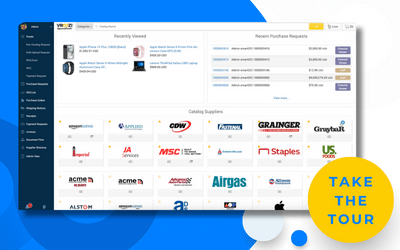
To learn more about how Vroozi can help you optimize supply chain forecasting and efficiently manage your spending, take a look at our free interactive product tour.