Today’s invoicing standards are more complex and nuanced than ever before.
Stricter government regulations present new challenges for staying compliant. Procurement digitization means operational efficiency is essential to gain a competitive advantage, and faster invoice processing times are essential for maintaining healthy supplier relationships.
Automated invoice processing helps organizations stay ahead of the curve by drastically cutting processing cycle times and costs while ensuring invoice data remains accurate and easily traceable. In this guide, we’ll help you understand automated invoice processing, how it works, and how to leverage it to empower your organization’s financial performance.
What is automated invoice processing?

Automated invoice processing refers to using digital systems, such as procure-to-pay software, to automate and streamline key tasks related to handling supplier invoices. It replaces manual workflows with digital processes that minimize errors, reduce human intervention, and shorten invoice processing times.
Traditional vs. automated invoice processing
Traditional invoice processing is labor-intensive, slow, and prone to errors.
If you receive hundreds of invoices every month, processing is a mountainous task that consumes valuable company time. Traditional processing also lacks transparency for stakeholders, limiting your ability to assess and react to valuable insights.
Conversely, automated invoice processing helps you streamline tasks (such as two- and three-way matching, approval routing, and payment posting) to improve operational efficiency while providing greater visibility to stakeholders. This naturally frees up more time and money that you can reinvest into more strategic, value-adding business activities.
Benefits of automated invoice processing
A recent study on Accounts Payable (AP) automation found that 52% of AP teams spend over 10 hours a week processing invoices. Whereas organizations that have embraced invoice processing automation achieve significant efficiency gains and substantial cost savings.
The benefits of automated invoice processing are numerous:
- Faster processing times. Invoice processing automation slashes the time from invoice receipt to approval, helping organizations avoid late payment penalties and capture early payment discounts.
- Increased visibility and control. Centralized invoice storage and real-time monitoring of invoice status improve the transparency and searchability of supplier invoices.
- Reduced processing costs. Automated invoice processing can reduce processing costs by 66% per invoice, unlocking greater cash flow and financial flexibility for your organization.
- Stronger supplier relationships. Automated invoice processing results in faster payments, increasing supplier satisfaction. Some invoice processing automation systems such as Vroozi even offer supplier portals for improved collaboration and invoice status tracking.
- Eliminates manual data entry errors. Invoice processing automation reduces the risk of incorrect data, duplicate payments, and overpayments. AI and machine-learning systems are designed to improve extraction accuracy over time, providing a compounding benefit for organizations.
In today’s highly competitive business environment, every efficiency gain counts.
As the world becomes more digitally connected, organizations that are proactive in optimizing their financial operations are best positioned to capitalize on opportunities and stay ahead of the competition.
“Automation and advanced technologies continue to move finance toward a digital future, allowing professionals to focus less on transactional activities and more on analytics and insights.”
How automated invoice processing works
Automated invoice processing streamlines critical steps in the invoice handling workflow, providing a multifaceted approach to greater efficiency and accuracy. To paint a clearer picture, let’s walk through the journey an invoice takes through an automated system like Vroozi.
First, an invoice arrives from your supplier—via email, government portal, or some other channel. Vroozi automatically captures it and extracts important data such as supplier details and line items.
Vroozi’s smart coding then accurately codes invoice lines with accounting based on your history and confidence scores. In a short time, Vroozi’s advanced machine-learning capabilities will improve data capture and coding accuracy with every invoice processed.
Next, Vroozi’s automated two- and three-way matching validates the invoice against the original purchase order and goods receipt documents.
Assuming there are no discrepancies, the invoice is routed for approval based on custom rules pre-defined by your organization. You can also enable touchless AP processing to automatically send payment to the supplier once a match is identified—freeing up time for your team to focus on other core business activities.
Invoice data is archived in a centralized system and synced with your ERP or accounting software in real time to create a clear audit trail and ensure organization-wide visibility and compliance.
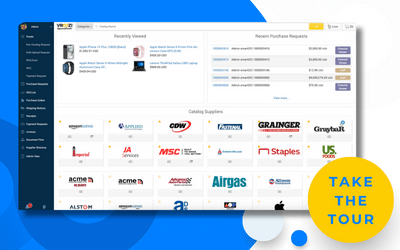
Bonus: Follow this process for yourself with our free interactive product tour.
Key steps in an automated invoice processing workflow
- Invoice receipt. Invoices arrive through various channels—for example, email attachments, supplier portals, and scanned paper invoices—which are then saved and stored regardless of format.
- Content extraction. The invoice automation system scans invoices, identifies key fields (such as line items and invoice numbers), and automatically extracts the data from each field.
- Data validation. Once extracted, data is validated against existing data to confirm accuracy and detect duplicate invoices. In some cases, missing information may be enriched if related master data exists.
- 2-way or 3-way matching. Invoice data is matched to the corresponding purchase order (and in the case of three-way matching, the receipt of the goods), to verify what was received is the same as what was invoiced. If all data matches perfectly, the invoice is automatically processed (touchless processing).
- Discrepancy identification. If discrepancies occur, such as mismatched quantities or prices, the invoice is flagged as an exception and the appropriate stakeholder is notified for resolution.
- Invoice approval. Matched invoices and resolved exceptions are automatically routed for approval based on your organization’s pre-defined approval hierarchies. Approvers can review and approve or reject invoices from a desktop or mobile device.
- Payment posting. Once an invoice has been fully processed and approved, the invoice data is automatically posted to your organization’s financial system—usually an ERP or accounting software—through a pre-established integration.
- Storage and reporting. Approved invoices and related documents such as POs and goods receipt notes are digitally stored in a centralized location for auditing, retrieval, and compliance purposes.
- Reporting and analytics. Real-time reporting provides transparency across the status of your ongoing invoices, while analytics tools offer valuable insights into financial performance—for example, processing times and historical spend.
Automated invoice processing systems

Automated invoice processing systems are digital solutions that enable processing automation and typically integrate with your existing accounting and ERP systems for real-time synchronization of invoice data.
They come in many forms, but the most common include:
- Basic AP automation software. These systems are designed solely to automate AP processes. They’re typically suitable for small organizations looking to solve specific AP pain points.
- AI-powered procure-to-pay (P2P) platforms. P2P software provides end-to-end functionality for procurement and finance teams, streamlining critical processes such as invoice processing and e-procurement to enable faster, more efficient workflows.
- ERP modules. Some ERP solutions offer custom add-ons or modules that slot into their existing functionality, seamlessly integrating AP with other automated operational workflows.
Increasingly, automated invoice processing systems are becoming a must-have for global organizations. As governments introduce new and stricter policies around e-invoicing, finance automation solutions like Vroozi are essential for ensuring easy auditing and compliance.
Choosing the best automated invoice processing software
Sorting through the growing number of automated invoice processing solutions is no easy task. If you select a system that’s not the right fit for your business, the time and money wasted on implementation presents a serious threat to your bottom line.
To find the best invoice automation software for your organization:
- Define your needs. Analyze your existing processes and identify problems or inefficiencies where automation may be the solution. Consider your core business objectives and speak to relevant stakeholders involved in invoice processing.
- Ensure e-invoicing compliance. Confirm that the software is fully compliant with the e-invoicing regulations of the countries you are selling or buying from. For example, Vroozi supports tax compliance with integrations for various governmental systems and a wide range of country-specific e-invoice formats.
- Align requirements with functionality. Check that the software provides the features needed to solve your specific problems. Many solutions offer a broad range of functionality, so it’s crucial you find a vendor that’s suitable for your organization’s size, industry, and business objectives.
Vroozi’s compliant AP invoice automation software offers a best-in-class procurement solution that intelligently manages purchases and payables. By leveraging AI and machine-learning functionality, Vroozi can help you simplify and streamline your end-to-end P2P cycle.
Implement automated invoice processing with Vroozi

Automated invoice processing helps streamline your AP workflows to optimize financial performance and ensure compliance with various tax authorities. Vroozi’s AI-powered spend management platform is easy to implement, compliant with regional e-invoicing mandates, and provides unparalleled efficiency gains for modern procurement teams.
In addition to AP invoice automation, Vroozi also comes with:
- A dynamic supplier marketplace for faster sourcing and purchasing
- End-to-end procure-to-pay functionality with multi-device access
- Seamless integrations with modern ERP systems, including SAP, IBM, and Microsoft Dynamics
- Real-time analytics that delivers actionable insights and 360-degree visibility
- An intuitive user interface that requires minimal training to get started
To find out if Vroozi is the right solution for your business, schedule a free demo today.