TL;DR: Procure-to-pay software challenges in 2026 typically show up as off-system buying, messy supplier data, missing purchase orders, manual approvals, inconsistent receiving records, disconnected AP automation, unclear exception routing, weak ERP integration, and late spend visibility.
Procure-to-pay workflow gaps are process breakdowns that prevent purchasing, approvals, supplier catalogs, purchase orders, receiving, invoices, payments, and ERP data from working together in one connected workflow.
Does your workflow need a bit of work? You know you could be more productive, more compliant, and more streamlined, if only your chosen platform was working in your favor.
Understanding exactly where the process breaks down, from purchase requests through supplier payment, is the first step toward fixing it.
This guide walks through nine of the most common procure-to-pay software challenges procurement leaders should watch for in 2026, along with how Vroozi’s procure-to-pay platform helps to solve them.
What Do We Mean When We Say “Workflow Gaps”?
Procure-to-pay workflow gaps are breakdowns that occur between purchasing, approvals, supplier data, purchase orders, invoices, and payment.
A “gap” simply means a point where information, approval, or accountability gets lost. These gaps lead to the procure-to-pay software challenges organizations face today.
Vroozi’s procure-to-pay platform is built around closing these gaps, connecting purchasing and accounts payable into a single, efficient workflow.
1. Purchasing Begins Outside the Approved Process
This happens when employees buy through email, informal requests, spreadsheets, or supplier websites instead of a controlled system.
Once a purchase happens off-system, procurement can no longer read demand. Finance only discovers the transaction after the invoice arrives, with no chance to negotiate pricing or confirm if the purchase was necessary.
Vroozi addresses this procure-to-pay software challenge through a guided marketplace buying experience. The easy user experience helps employees use approved suppliers without needing a separate workaround. Gap = Closed.
2. Supplier and Catalog Data Are Fragmented
Outdated records. Inconsistent pricing. Unauthorized vendors. It all leads to fragmented supplier and catalog data.
Upstream issues are a major contributor to procure-to-pay software challenges further down the workflow. For example, if the price on an invoice doesn’t match what’s in the system, AP has to stop and investigate manually.
Vroozi Marketplace centralizes supplier catalogs, preferred vendors, and contract pricing in one place. This helps keep centralized supplier and catalog data easier to access and manage.
3. Purchase Orders Are Missing or Incomplete
Missing or incomplete purchase orders make it difficult for accounts payable to confirm what was actually approved.
Among procure-to-pay software challenges, this one directly slows down invoice processing. Without a clean PO, AP teams can’t easily verify quantity, pricing, or approval status. That uncertainty creates delays and increases the risk of overpayment.
Vroozi’s procure-to-pay platform helps reduce this problem by automating PO creation from approved requests, increasing efficiency, and reducing errors.
4. Approved Rules Are Too Confusing
When approval rules aren’t built into the purchasing system, they must be remembered or added manually. This causes endless delays.
Manual approval routing is one of the most persistent procure-to-pay software challenges because it relies on people remembering to act. This often means that requests and invoices sit in inboxes waiting for sign-off. Meanwhile, AP teams spend valuable time chasing down approvers instead of processing payments.
Vroozi’s procure-to-pay platform automates approval routing based on rules like amount, supplier, department, category, project, or cost center, reducing guesswork and helping requests move through the right approval path.
5. Receiving Data Isn’t Captured Correctly
Incomplete or inaccurate receiving data is one of the most common causes of invoice matching delays for AP teams.
This gap creates one of the more frustrating procure-to-pay software challenges for AP teams, since missing receipts turn routine invoices into exceptions, meaning even more manual checks before an invoice can move forward.
Vroozi’s procure-to-pay platform offers better receiving visibility, making two-way and three-way matching much easier.
6. AP Automation Is Disconnected From Procurement
AP automation fails when there is a disconnect between invoice capture and purchasing data.
This limits automation to a fraction of the workflow. For example, when AP teams must manually research supplier details, POs, receipts, and approvals, the “automation” only accelerates one step of a far longer process.
Vroozi brings purchasing and AP together, so invoice processing starts with better, cleaner data.
7. Invoice Exceptions Aren’t Routed Properly
Invoice exceptions should be routed automatically to the person responsible for resolving the specific issue.
That’s it. They don’t need to become fully acquainted with every member of your processing team.
Unclear exceptions turn every discrepancy into a manual investigation. Without defined workflows, AP teams end up resolving the same types of problems from scratch each time, taking valuable time away from other tasks.
Vroozi supports exception-based workflows, allowing AP teams to focus their attention on invoices that genuinely need review.
8. ERP Integration Creates Twice the Work
Poor ERP integration forces teams to re-enter purchasing and invoice data manually, simultaneously wasting time and increasing errors.
Weak integration is one of the more expensive procure-to-pay software challenges because it multiplies work across two systems.
Vroozi’s procure-to-pay platform integrates seamlessly with systems like SAP, Oracle, NetSuite, and Microsoft Dynamics through pre-built connectors, keeping purchasing and invoice data aligned with the system of record.
9. Spend Visibility Arrives Too Late
Late spend visibility happens when procurement and finance teams only see spend after invoices arrive. By then, the purchase has already been made, the supplier has already been selected, and the budget impact may already be locked in.
Vroozi helps teams track requested, approved, ordered, invoiced, and paid spend across the procure-to-pay process, giving leaders earlier visibility into committed and actual spend.
Common P2P Workflow Gaps and What to Evaluate
| Workflow Gap | What Breaks Down | What to Evaluate in a Replacement Approach |
|---|---|---|
| Off-system purchasing | Spend starts outside approved channels. | Marketplace buying and guided purchasing. |
| Fragmented supplier data | Buyers use inconsistent supplier records or pricing. | Centralized supplier catalogs and contract controls. |
| Missing purchase orders | AP cannot verify what was approved. | Automated PO creation from approved requests. |
| Manual approvals | Requests and invoices stall. | Rule-based approval routing and reminders. |
| Missing receiving data | AP cannot confirm delivery or completion. | Receipt tracking and matching workflows. |
| Disconnected AP automation | Invoice tools lack procurement context. | Connected purchasing, PO, invoice, and payment workflows. |
| Poor exception routing | AP manually researches every issue. | Exception workflows by issue type and owner. |
| Weak ERP integration | Teams re-enter and reconcile data manually. | ERP-friendly integration and clean data flow. |
| Late spend visibility | Leaders only see spend after invoices arrive. | Dashboards for committed and actual spend. |
FAQ: Procure-to-Pay Workflow Gaps
Q: What are procure-to-pay workflow gaps?
A: Procure-to-pay workflow gaps are breakdowns that occur between purchasing, approvals, supplier data, purchase orders, invoices, ERP systems, and payments. They underlie most procure-to-pay software challenges organizations face.
Q: Why does manual invoice processing happen?
A: Manual invoice processing results from invoices that arrive without clean PO data, receipt confirmation, supplier records, or clear approval routing.
Q: Why do AP automation rollouts fail?
A: AP automation rollouts fail when invoice capture is not connected to upstream procurement workflows, supplier catalogs, purchase orders, receipts, and ERP data.
Q: What should procurement leaders evaluate before replacing P2P software?
A: Before replacing P2P software, procurement leaders should assess user adoption, supplier catalog control, approval workflows, PO quality, AP automation, ERP integration, exception routing, and spend visibility.
Q: How does Vroozi help close P2P workflow gaps?
A: Vroozi’s procure-to-pay platform connects marketplace buying, supplier catalogs, approvals, purchase orders, invoice automation, ERP integration, and spend visibility in one easy-to-use workflow, directly addressing common procure-to-pay software challenges.
Procurement Leaders Choose Vroozi
Procure-to-pay software challenges aren’t something you need to “just put up with.” With Vroozi’s procure-to-pay platform, you get an intuitive, marketplace-first buying experience, plus centralized supplier catalogs, approvals, purchase orders, invoice automation, ERP integration, spend visibility, and more, all in a single workflow.
The best part is that you don’t even need to “rip and replace” your old system. Vroozi layers on with its snap-on architecture, so you can get up and running quickly.
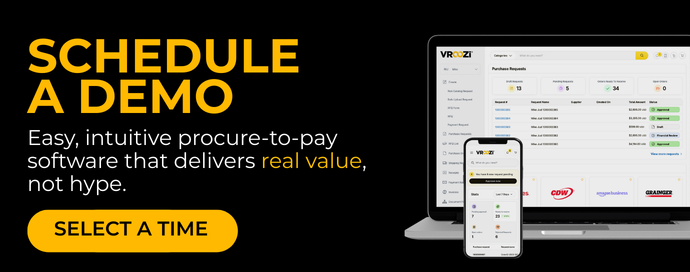
Schedule a demo with Vroozi to map your procure-to-pay software challenges and evaluate a more efficient path forward.